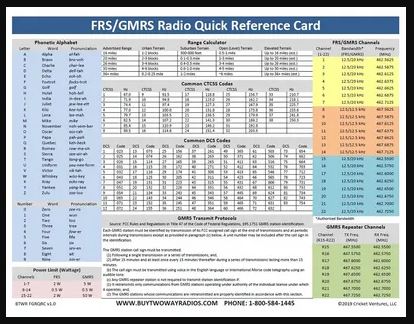
The list below shows active local GMRS repeaters in the area that are available to the public.
| Frequency | Name | Tone |
|---|---|---|
| 462.5500 | Purcellville (VA) | 77.0 |
| 462.5500 | Seven Corners (VA) | 141.3 |
| 462.5750 | Clarendon (VA) | 141.3 |
| 462.6000 | Alexandria (VA) | 141.3 |
| 462.6250 | Wheaton (MD) | 141.3 |
| 462.6500 | Ashburn (VA) | 146.2 |
| 462.6750 | Seven Corners (VA) | 141.3 |
| 462.7000 | Dulles (VA) | 146.2 |
| 462.7000 | Washington (DC) | 141.3 |
| 462.7250 | Warrenton (VA) | 146.2 |
Due to the number of repeaters in our Area of Operations, N.C.R. REACT serves as a clearinghouse and volunteer frequency coordinator for those who seek deconfliction guidance and mediation. Our N.C.R. REACT Spectrum Manager keeps extensive records of repeater input, output and control frequencies, including those not published in directories (at the owner's request). N.C.R. REACT can recommend frequencies for a proposed repeater in order to minimize interference with other repeaters and simplex operations. Therefore, anyone considering the installation of a repeater should check with experts prior to any installation. Repeater coordination with GMRS is not required by the Federal Communications Commission (FCC), nor does the FCC regulate, certify, or otherwise regulate frequency coordination. This is true for both GMRS and Amateur Radio. While the AARL has volunteer coordinators nationwide, GMRS does not. The purpose of a repeater/frequency coordination entity is to try to keep interference between repeaters and their users to a minimum. Repeater Coordinators or coordination groups are all volunteers and have no legal authority to assume jurisdictional or regional control in any area where the Federal Communications Commission regulates the Radio Service. The purpose of coordinating a repeater or frequency is to reduce harmful interference to other fixed operations. Coordinating a repeater or frequency with other fixed operations demonstrates good engineering practice. One of our N.C.R. REACT members will be glad to assist other repeater owners with selection of frequencies, tones and deconflicting overlap within the geographic area in GMRS' limited spectrum.
We couldn't do what we do without these valued technologies.
We work with trusted communications companies to support our mission.